




First Time Buyers: Buy Homeowners Insurance 30–45 Days Before Closing

Buy homeowners insurance as soon as your offer is accepted, not the week before closing. Shop for 30 to 45 days, then bind the policy so its effective date matches your closing date. Your lender won’t fund the loan without a declarations page or binder proving coverage is active, so treat that paperwork as a deadline, not an afterthought.
TL;DR:
Most lenders require proof of homeowners insurance within 3 to 10 business days before closing, so your policy must be bound and documented well in advance.
Binding your coverage 7 to 14 days before closing, with an effective date aligned to your closing day, minimizes delays caused by missing paperwork.
A mortgagee clause with correct lender details on your declarations page or binder is essential to avoid delays or force-placed insurance at a higher cost.
Insure your home for its rebuild cost using a replacement estimate, and compare at least three quotes to prevent underinsurance or overpaying.
For properties in flood or high-risk zones, start the insurance process immediately after offer acceptance, as coverage and waiting periods can extend timelines.
Table of Contents
When Should You Buy Homeowners Insurance? A Step-by-Step Timeline
The clock starts the day your offer gets accepted, not the day you sign closing documents. You typically have a 30 to 45 day window between offer acceptance and closing, and that stretch is exactly when you should be requesting quotes, comparing dwelling limits, and flagging any underwriting red flags before they become closing problems.
Aim to bind your policy about one to two weeks before closing. Binding early doesn’t mean paying twice or losing coverage flexibility. It means your carrier has time to issue the declarations page and your lender has time to review it. Set the policy’s effective date to match your closing date exactly. Most policies take effect at 12:01 AM on that date, and a binder covers you in the gap while the full policy gets processed.
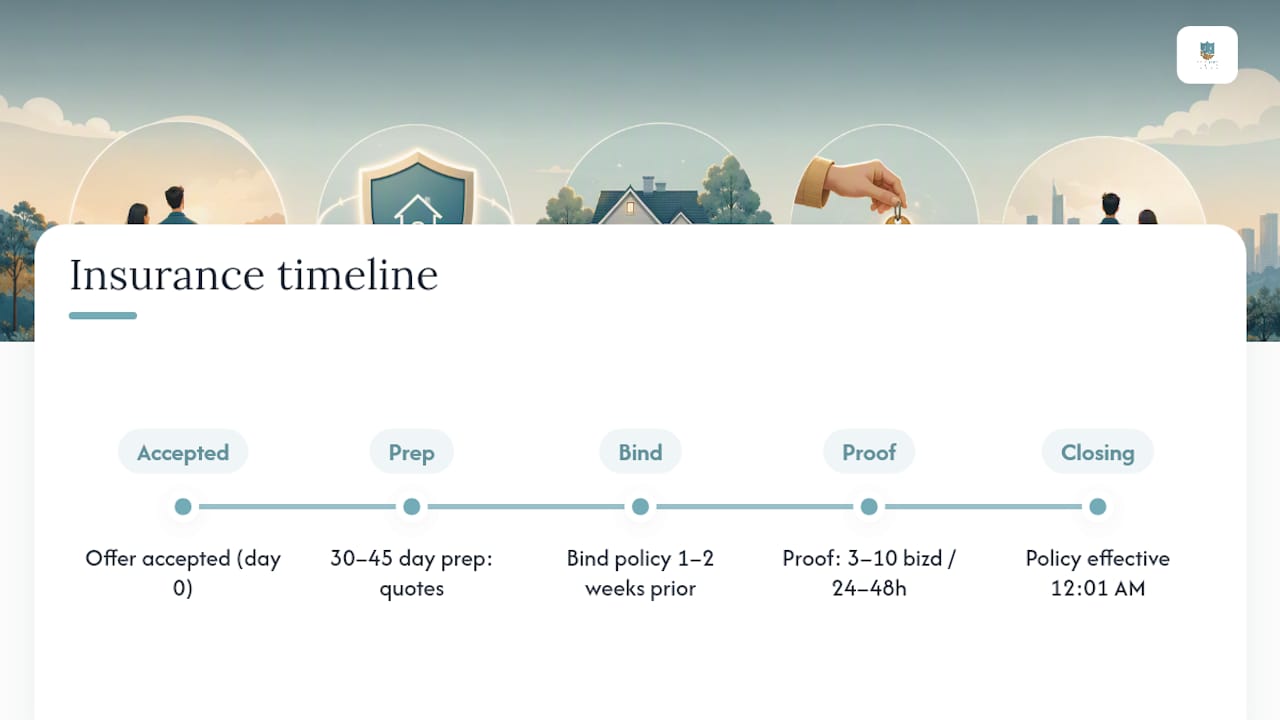
Lenders vary on how much lead time they demand for proof of insurance. Some want it 3 to 10 business days before closing; others cut it close and ask for 24 to 48 hours. Ask your loan officer early which window applies to your file, because guessing wrong here is how closings get pushed.
Closing dates move constantly in real estate, sometimes with just a few days’ notice. If yours shifts, call your agent immediately to adjust the policy’s effective date. Carriers handle this routinely, but only if you tell them before the old date passes, not after.
What Do Lenders Actually Require Before Funding?
Lenders don’t just want to know you have insurance. They want specific documents that name them correctly and prove coverage starts on time. Two documents matter here, and they’re not interchangeable.
A binder is a temporary certificate your carrier issues confirming coverage is in force while the full policy gets finalized, and it typically holds for 30 to 60 days. The declarations page, often just called the “dec page,” is the permanent summary of your policy: coverage limits, deductibles, and the mortgagee clause. Lenders generally accept either as proof, but title companies often want the dec page in hand before they’ll release funds.
That mortgagee clause deserves attention. It names your lender as a loss payee, meaning the lender gets notified if the policy lapses and gets paid first on major claims. If your lender’s name or loan number is misspelled or missing, the document can bounce back and cost you days you don’t have.
A few practical rules keep this from becoming a fire drill:
Send proof directly to your lender and your title company or closing agent, not just one or the other.
Confirm the mortgagee clause wording with your lender before you send anything, since correcting it after submission adds delay.
Ask your closing agent exactly which document, binder or dec page, they need and by what date.
Miss these deadlines and lenders can, and do, force-place insurance on your behalf. That coverage is expensive, offers minimal protection, and gets added straight to your mortgage payment.
How Do You Choose the Right Coverage Before You Bind?
Insure your home for what it would cost to rebuild it, not what you paid for it. These two numbers are rarely close. A replacement-cost estimator calculates rebuild cost using square footage, materials, and local construction prices, which usually lands well above or below your purchase price depending on the market. Lenders typically require a dwelling limit tied to that replacement cost or your loan balance, whichever is higher.
Get at least three quotes before you bind anything. Comparing carriers matters because dwelling limits, deductibles, and endorsements (extra protections like water backup or scheduled jewelry) vary widely for the same house. A cheap premium with a low dwelling limit isn’t cheap if it leaves you underinsured after a fire.
Check your quotes against your lender’s minimums for dwelling coverage and liability before you commit. If your quote falls short, fix it now rather than during the week of closing.
Pro Tip: If your home has an older roof or you’ve had recent claims at a previous address, mention it to your agent on day one. Underwriting on higher-risk properties takes longer, and some carriers decline outright, so surfacing these issues early avoids a scramble two weeks before closing.
A few habits make the shopping process smoother:
Run a replacement-cost estimate before requesting quotes so every carrier is pricing the same target.
Ask each carrier directly whether roof age, claims history, or prior water damage affects eligibility.
Some analysts suggest shopping between January and April tends to land more favorable rates ahead of storm season pricing adjustments, though your closing timeline will usually dictate more than the calendar will.
What Will You Pay at Closing, and How Does Escrow Work?
Expect to pay your full first-year premium at closing, either directly to the carrier or as a deposit into an escrow account your lender sets up. This is separate from your down payment and closing costs, so budget for it as its own line item.
Once you close, most lenders escrow future premiums, meaning they collect a portion each month alongside your mortgage payment and pay the insurer directly when the policy renews. Your monthly payment reflects that split between principal, interest, taxes, and insurance.
Some lenders allow you to pay premiums directly instead of escrowing them, though this depends on your loan type and down payment size. If you go this route, set a reminder well before renewal, since a missed payment here has the same consequence as a missed mortgage payment: the lender can step in and force-place coverage.
A few things affect how this plays out over time:
If your premium rises at renewal, your escrow payment adjusts, and you may see a short-term shortage that gets spread across future payments.
Ask your lender whether an escrow analysis happens annually or if changes get applied immediately.
Keep your dec page updated with your lender any time you switch carriers, since escrow disbursements go to whoever is on file.
What About Cash Buyers, Flood Zones, or Declined Coverage?
Buying with cash means no lender is forcing your hand, but insuring from day one is still the smart move. A total loss with no coverage and no lender safety net falls entirely on you.
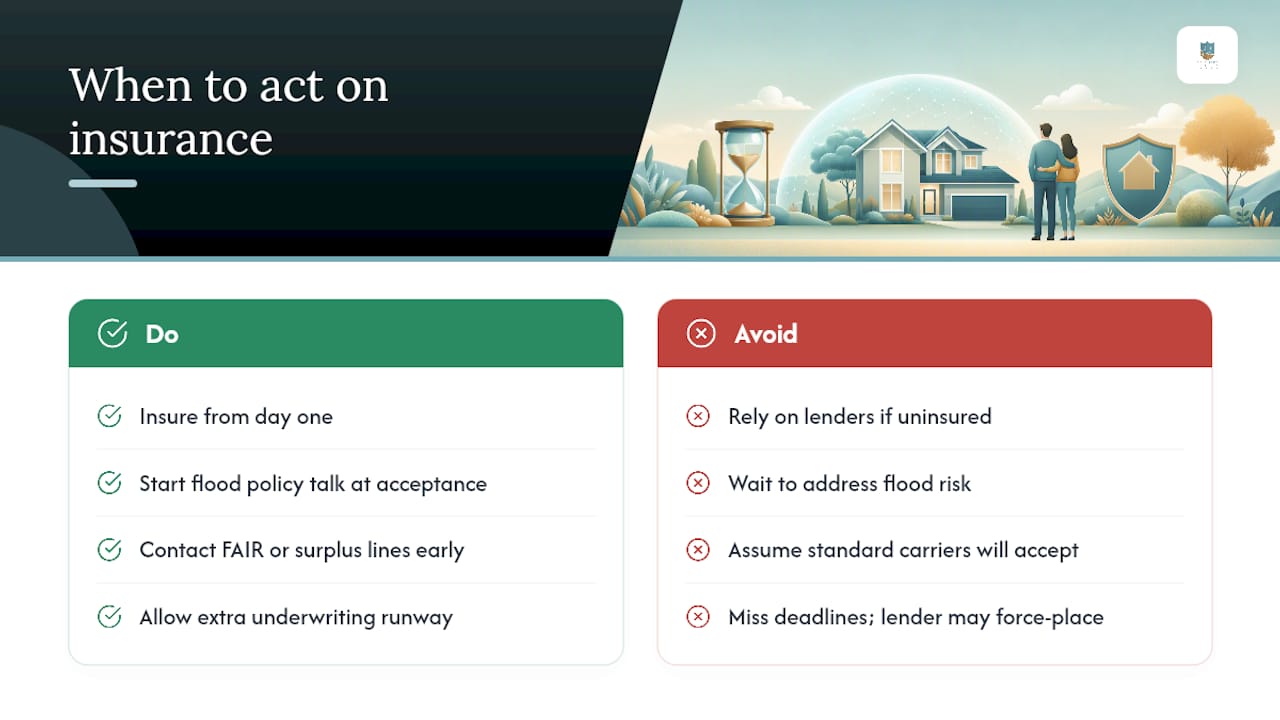
Properties in high-risk flood or wildfire zones often need action earlier than the standard timeline. Flood coverage is a separate policy from standard homeowners insurance, and lenders require it when a property sits in a mapped high-risk flood zone. Start that conversation the moment your offer is accepted, since flood policies sometimes carry longer waiting periods before coverage kicks in.
If your property’s risk profile pushes standard carriers to decline coverage, look into a state FAIR plan or a surplus lines carrier. These exist specifically for hard-to-place homes, but they take longer to underwrite, so give yourself extra runway if your house has a history of claims or sits in a catastrophe-prone area.
Force-placed insurance is what happens when none of this gets handled in time. Your lender buys a policy on your behalf, often at several times the cost of a policy you’d choose yourself, with far less protection.
Your Closing-Day Insurance Checklist
Work through these steps roughly in order, starting the day your offer is accepted:
Gather your property details: square footage, year built, roof age, and construction type.
Run a replacement-cost estimate to determine your dwelling coverage target.
Request quotes from at least three carriers and compare limits, deductibles, and endorsements.
Choose a policy and confirm the mortgagee clause wording with your lender.
Bind the policy 7 to 14 days before closing with an effective date matching your closing date.
Get the declarations page or binder from your carrier.
Send proof to both your lender and your title company or closing agent.
If a deadline sneaks up on you, most carriers can issue a same-day binder to bridge the gap while the full policy processes. It’s a workaround, not a habit, but it can save a closing that’s about to slip.
Why Timing Matters More Than People Think
Most homebuyers treat insurance as a checkbox instead of a coordination problem. It’s really the latter. Getting the effective date wrong, or picking a dwelling limit based on purchase price instead of rebuild cost, causes more closing delays than anything else in this process. An independent broker who shops 20+ carriers and talks to your lender directly removes most of that risk, because someone is watching the mortgagee clause and the deadline calendar instead of you juggling it alone during the busiest weeks of your life.
— Andrew
Get Coverage Locked In Before Your Closing Date Arrives
South Lake Agency Insurance Brokers exists for exactly the scenario this article walks through: a closing date on the calendar and a lender who needs proof of coverage, fast. We shop your policy across 20+ carriers, confirm your mortgagee clause wording before it becomes a problem, and send your declarations page directly to your lender and title company.

There are brokers who charge no fees for this service and who work directly with lenders in Minnesota and the Midwest who process these files daily, making the timeline familiar to them. If you’re inside that 30 to 45 day window after an accepted offer, compare homeowners insurance quotes now or request a quote directly and we’ll build your binding timeline around your actual closing date.
Where This Guidance Comes From
This guide draws on lender proof-of-insurance standards, the CFPB’s consumer guidance on why insurance is required, and industry timing data from Coverage Classroom.
This article is general information, not a substitute for advice from a qualified financial advisor. Consult a qualified financial professional about your own circumstances before acting on anything here.
Sources
FAQ
How much should home insurance be on a $400,000 house?
Coverage should reflect rebuild cost, not sale price, so a house could need a dwelling limit well above or below that number depending on local construction costs. Run a replacement-cost estimate rather than insuring to the purchase price, since that’s the figure lenders check against your loan balance.
What is the 80/20 rule for home insurance?
The 80/20 rule generally refers to insuring your dwelling for at least 80% of its full replacement cost to avoid a coinsurance penalty on partial claims. Falling below that threshold means your insurer may reduce a claim payout proportionally, even for damage far smaller than a total loss.
What does Dave Ramsey say about homeowners insurance?
Dave Ramsey’s general guidance is to shop around, choose adequate dwelling and liability coverage, and avoid being underinsured just to save on premium. That advice lines up with insuring to replacement cost and comparing at least three quotes before binding a policy.
Will homeowners insurance go down in 2026?
Premium trends vary heavily by state and risk exposure, and no single national figure applies to every homeowner. Shopping multiple carriers, ideally between January and April, remains one of the more reliable ways to find a competitive rate regardless of broader market shifts.
Do I need proof of insurance before or after closing?
Proof of insurance is required before closing, since lenders won’t fund the loan without it. Most lenders ask for a declarations page or binder 3 to 10 business days ahead of the closing date, so send it as soon as your policy is bound.
Recommended
Comments