




Broker Backed Life Insurance Rates: $50 at 40, $280+ at 60


Age drives life insurance pricing more than any other factor. A healthy 25-year-old often pays under $20 a month for $500,000 in term coverage, while the same policy can run $150 or more for someone in their 60s. Premiums climb gradually through your 30s, then accelerate hard after your mid-40s. The move that saves you the most money is simple: lock in a policy now rather than waiting, and compare quotes from multiple carriers instead of accepting the first offer.
TL;DR:
Buying life insurance early locks in significantly lower premiums, especially before age 45 when rates accelerate rapidly each decade.
A healthy 40-year-old pays around $47 to $59 monthly for a $500,000, 20-year term, while that cost can increase to over $280 at age 60.
Whole life policies cost several times more than term policies at any age and are better suited for lifelong coverage and estate planning goals.
Tobacco use and health conditions like diabetes can double or triple premiums regardless of age, and insurers vary widely in how they rate these factors.
Comparing multiple carriers and understanding your health and lifestyle profile can save hundreds of dollars, especially as age-related costs rise sharply after 45.
Table of Contents
How Life Insurance Rates by Age Actually Break Down
The clearest way to see age-based pricing is to look at a single benchmark and hold everything else steady. Using a $500,000, 20-year term policy for a healthy nonsmoker, the average monthly cost at age 40 runs about $47 for women and $59 for men, and most buyers across all ages land somewhere between $30 and $100 a month depending on health and coverage.
Here’s how that same benchmark typically shifts across the decades for a healthy nonsmoker:
Age | Approximate Monthly Premium ($500K, 20-year term) |
25 | $18 to $26 |
30 | $18 to $26 |
40 | $47 to $59 |
50 | $110 to $150 |
60 | $280 to $360 |
70 | $700 or more (often limited term length options) |
Women tend to pay less than men at every age because of longer average life expectancy, and smokers routinely pay two to three times the nonsmoker rate regardless of age. A 60-year-old smoker shopping for the same $500,000 term policy can expect significantly higher premiums than a nonsmoker of the same age.
Whole life tells a different story. A $500,000 whole life policy for a 40-year-old can run several times the monthly cost of the equivalent term policy, and that gap only widens with age, since whole life premiums increase steadily and stay elevated for life.
Statistic Callout: For a healthy 40-year-old, a $500,000, 20-year term policy averages $47 a month for women and $59 a month for men. The same coverage in a whole life policy typically costs several times more per month.
Three patterns stand out in this data:
Rates tend to increase significantly every decade after your late 30s.
The increase in premiums from 50 to 60 is often steeper than that from 40 to 50.
Gender and tobacco use can each shift the price by 20% to 200%, depending on the carrier.
These are averages for healthy applicants in a preferred or standard risk class. Your actual quote will move up or down based on the underwriting factors covered later in this guide.
Term vs. Whole Life: Why the Cost Curve Looks So Different
Term life insurance covers you for a fixed period, usually 10 to 30 years, and the price you lock in at the start stays flat for that entire term. That’s the appeal: a 35-year-old who buys a 20-year term policy pays a 35-year-old’s rate until age 55, even though the same coverage bought fresh at 55 would cost several times more.
Whole life insurance works differently. It never expires as long as you pay the premium, and it builds cash value over time, but that permanence comes at a real cost. Whole life premiums are set higher from day one and continue rising with age if you buy new coverage later rather than locking in a policy young.
A few practical distinctions worth knowing before you choose:
Term is almost always the better age-based value if your main goal is replacing income or covering a mortgage for a set number of years.
Whole life makes more sense when you want guaranteed lifelong coverage, estate planning benefits, or a forced savings component through cash value.
Buying whole life young locks in a lower lifetime premium than waiting, but the monthly cost still exceeds term at every comparable age.
If you’re weighing the tradeoffs in more depth, our comparison of term versus whole life walks through when each policy type actually pays off.
What Else Insurers Weigh Beyond Your Age
Age sets the baseline, but insurers stack several other variables on top of it to land on your final rate. Here’s what carries the most weight:
Health history and current conditions. Diabetes, heart disease, and high cholesterol can each push you into a higher rate class regardless of age.
Tobacco use. Smokers typically pay two to three times more than nonsmokers at the same age.
BMI, blood pressure, and cholesterol. These numbers, gathered during underwriting, often decide whether you land in preferred, standard, or a rated class.
Coverage amount and term length. A $1 million policy costs proportionally more than $250,000, and a 30-year term costs more than a 10-year term at the same age.
Occupation and hobbies. Pilots, commercial divers, and anyone racing motorcycles competitively will see rate adjustments.
Driving record. Multiple DUIs or reckless driving citations can move you into a higher-risk category.
Underwriters sort applicants into rate classes, from preferred plus down through standard and into “table ratings,” which are common at older ages or with health complications. Each table rating step typically adds around 25% to the base premium, so someone rated Table 2 might pay roughly 50% more than a standard applicant of the same age.
Pro Tip: If you get a table rating you think is unfair, ask your broker to shop the same health profile with a different carrier. Underwriting guidelines for the same condition vary significantly from company to company.
What Happens During a Life Insurance Medical Exam
Most policies above $250,000 require a medical exam as part of underwriting. The exam itself includes a health questionnaire, height and weight measurements, blood pressure readings, and blood and urine samples, and it typically takes 30 to 45 minutes. The insurer pays for it, and results usually come back within a few business days.
No-exam and simplified-issue policies exist, but they typically cost 20% to 50% more than fully underwritten coverage for the same face amount.
Accelerated underwriting programs use third-party data instead of a lab draw for some healthy applicants, occasionally matching fully underwritten pricing.
Applicants age 60 and older sometimes face additional cognitive or mobility screening during underwriting, making it important to consider options like the best dental insurance for seniors with no waiting period for ancillary health preparation.
Statistic Callout: Fully underwritten policies with a medical exam generally produce the lowest premiums, because the exam reduces the insurer’s uncertainty about your risk. Skipping the exam usually means paying more for the same coverage.
Sleep well, stay hydrated, and avoid nicotine and heavy caffeine before your exam. Small adjustments like these can influence your blood pressure and lab results enough to matter for your rate class.

When and How to Lower Your Premium
Buying earlier is the single biggest lever you control. Rates increase gradually through your 30s, then accelerate sharply after age 45, so a policy bought at 44 can lock in years of savings compared to waiting until 47.
Get quotes from several carriers rather than relying on one company’s offer.
Work with a broker who can match your health profile to the carrier with the most favorable underwriting for your situation.
Choose the shortest term length that actually covers your need, whether that’s your mortgage payoff date or your kids’ college years.
Quit tobacco use well before applying; most insurers require 12 months of being smoke free for nonsmoker rates.
Improve controllable metrics like blood pressure and weight before your exam date, not after you apply.
Pro Tip: Run your numbers through a term life insurance needs calculator before you apply. Knowing your real coverage need keeps you from overbuying and paying more than necessary.
How Credit Score Can Influence Life Insurance Pricing
Most life insurers don’t pull a traditional credit score, but many use a related tool: credit-based insurance scores, which factor into underwriting in states that permit it. Unlike auto or home insurance, where credit-based scoring is common and explicit, life insurers weigh it more subtly, often as one data point among many in accelerated underwriting programs that use third-party financial and behavioral data instead of a blood draw.
A poor credit history can signal higher risk to some underwriters, occasionally nudging an applicant toward a standard rate instead of preferred, even when health metrics look strong. It rarely overrides major factors like age, tobacco use, or a serious medical condition, but it can tip a borderline case in either direction.
The practical takeaway: cleaning up your credit report before applying won’t guarantee a better rate, but it removes one more variable that could work against you. If you’re using an accelerated underwriting program that skips the medical exam, your financial history carries more weight in that pricing model than it would in traditional underwriting with a full lab panel. Ask your broker directly whether the carrier you’re considering factors credit data into its decision, since practices vary widely by company and by state.
Impact of Pre-Existing Medical Conditions on Age-Related Pricing
A pre-existing condition rarely disqualifies you from coverage, but it almost always changes the math, and that change gets more expensive as you get older. A 30-year-old with well-controlled type 2 diabetes might see a modest rate bump. A 55-year-old with the same diagnosis, plus a few extra years of elevated blood pressure readings, could land in a table-rated class that adds a meaningful percentage to an already higher base premium for their age.
Chronic conditions like diabetes, hypertension, and obesity commonly push applicants into higher rate classes or trigger table ratings, and the effect compounds with age because older applicants already start from a higher baseline rate. That’s the real risk of waiting: a health condition diagnosed at 50 doesn’t just add its own cost, it stacks on top of a rate that was already going to be higher than it would have been at 35.
The good news is that underwriting guidelines for the same condition differ significantly between carriers. One insurer might rate a controlled autoimmune condition mildly, while another applies a steeper penalty for the same lab results. This is where shopping multiple carriers pays off most, particularly for applicants over 50 who are already absorbing the standard age-based rate increase. Getting matched with the carrier whose underwriting team looks favorably on your specific condition can offset a meaningful chunk of what age alone would otherwise cost you.
Sample Quotes Across Insurers Show How Much Age Moves the Number
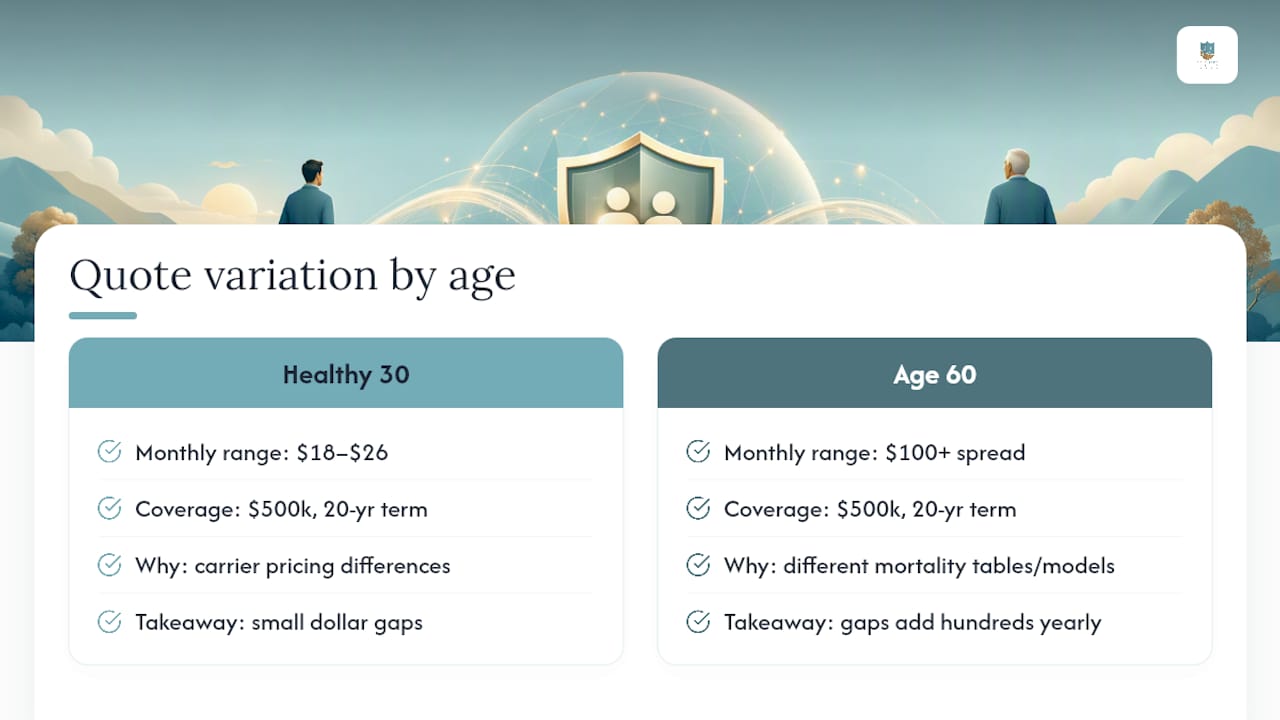
Rate variation between carriers can be just as important as the age-based averages, because two people of the same age and health profile can get meaningfully different quotes depending on which company underwrites them. For a $500,000, 20-year term policy, a healthy 30-year-old might see quotes ranging from around $18 a month at one carrier to $26 a month at another for functionally identical coverage. That gap tends to widen at older ages: a 60-year-old shopping the same coverage could see a spread of $100 a month or more between the least and most competitive offers.
This spread exists because each insurer builds its own mortality tables and risk models, and some carriers specialize in favorable pricing for certain age brackets, health profiles, or occupations. A carrier that prices aggressively for applicants in their 30s isn’t necessarily the same one offering the best rate to a 65-year-old with a history of high cholesterol.
That’s the practical argument for comparing quotes rather than accepting the first number you see. A single quote tells you what one company thinks you’re worth as a risk. Multiple quotes tell you where your actual price floor sits, and at older ages, where the dollar amounts are larger, that difference between the highest and lowest offer can add up to hundreds of dollars a year.
Why Rate Charts Only Tell Half the Story
Sample rate charts are useful, but they show averages for healthy applicants, not your actual quote. That gap is where a broker’s underwriting knowledge pays off. Many insurance brokers work with more than 20 carriers, each with its own underwriting rules for age, health history, and lifestyle factors.
That variation means a 55-year-old with a manageable health condition might get a standard rate from one carrier and a table rating from another for the exact same profile. Shopping multiple carriers to find the best underwriting match can be done without added broker fees at some agencies. Running your numbers through a needs calculator before requesting quotes gives you a realistic target instead of a guess.
— Andrew
Get a Personalized Life Insurance Quote by Age
Sample rate charts tell you what a healthy stranger your age typically pays. They can’t tell you what you’ll actually pay once your health history, tobacco status, and coverage goals enter the picture. Some brokers shop your profile across multiple carriers to find the underwriting class and price that fits you, sometimes at no added broker fee.

Because pricing and underwriting rules vary by carrier, especially past age 45 when rates start climbing fastest, having someone compare offers on your behalf can be better than going direct to a single insurer. Start by running your coverage needs through our Term Life Insurance Needs Calculator, then request a personalized life insurance quote to see what your actual age, health profile, and coverage goals translate to in real dollars.
FAQ
How Much Is a $500,000 Life Insurance Policy for a 60-Year-Old Man?
A healthy 60-year-old man typically pays somewhere between $280 and $360 a month for a $500,000, 20-year term policy, though smokers and applicants with health conditions can pay significantly more.
How Much Does a $100,000 Whole Life Insurance Policy Cost per Month?
Costs vary widely by age and health, but whole life premiums generally run several times higher per month than an equivalent term policy at the same age, since whole life combines lifelong coverage with a cash value component.
Is It Worth Getting Life Insurance at 62?
It can be, especially if you still have dependents, debt, or want to leave money for final expenses; premiums are higher in your 60s than at 40, but a broker who shops multiple carriers can often find a more competitive rate than a single direct quote.
Is It Worth Getting Life Insurance at 70 Years Old?
Term coverage becomes harder to find and more expensive at 70, so many applicants at this age look at guaranteed-issue or simplified whole life policies instead, typically for smaller death benefits meant to cover final expenses rather than income replacement.
Recommended
Comments